CGAP: A Hybrid Contrastive and Graph-based Active Learning Pipeline to Detect Water and Sediment in Multispectral Images
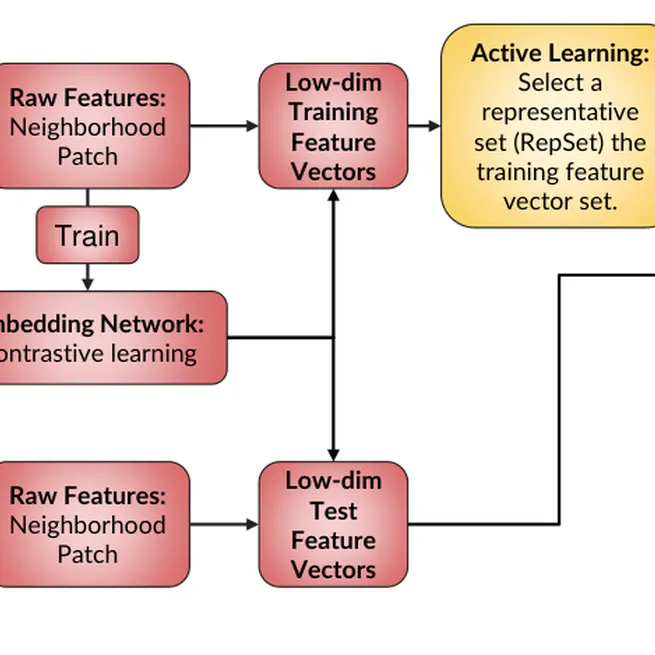
The contrastive graph-based active learning pipeline (CGAP) combines a learned feature embedding with graph Laplace learning to classify land, surface water, and near-water sediment in Landsat imagery. Custom contrastive augmentations make the features robust to geometric transformations, changes in spatial resolution, and light cloud cover while reducing the dimension used for graph construction.
Jun 7, 2024
Batch Active Learning for Multispectral and Hyperspectral Image Segmentation Using Similarity Graphs
This paper develops a graph-based pipeline for label-efficient multispectral and hyperspectral image segmentation. Pixels or local image patches are embedded as nodes of a similarity graph, and graph Laplace learning propagates the small number of queried labels across the image.
Jun 1, 2024
Graph-Based Active Learning for Nearly Blind Hyperspectral Unmixing
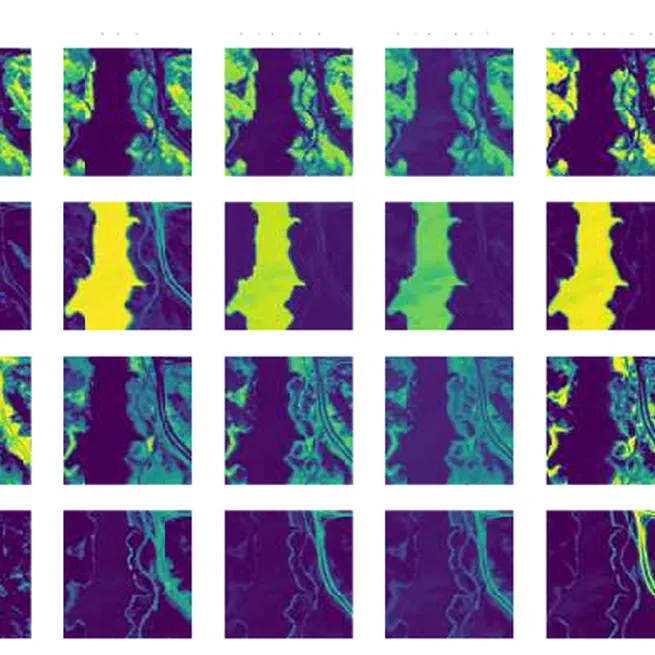
This work formulates nearly blind hyperspectral unmixing as a semi-supervised problem: instead of assuming all endmember spectra are known, it requests abundance information or simple one-hot pseudo-labels for only a very small set of pixels selected by graph-based active learning.
Sep 11, 2023
Graph-Based Active Learning for Surface Water and Sediment Detection in Multispectral Images
The graph active learning pipeline (GAP) treats multispectral pixels as nodes in a similarity graph and uses graph Laplace learning to distinguish land, surface water, and in-river sediment. An acquisition function identifies the pixels whose expert labels are expected to improve the classifier most, directly targeting the expensive step of building a hand-labeled remote-sensing dataset.
Jul 1, 2023
Novel batch active learning approach and its application to synthetic aperture radar datasets
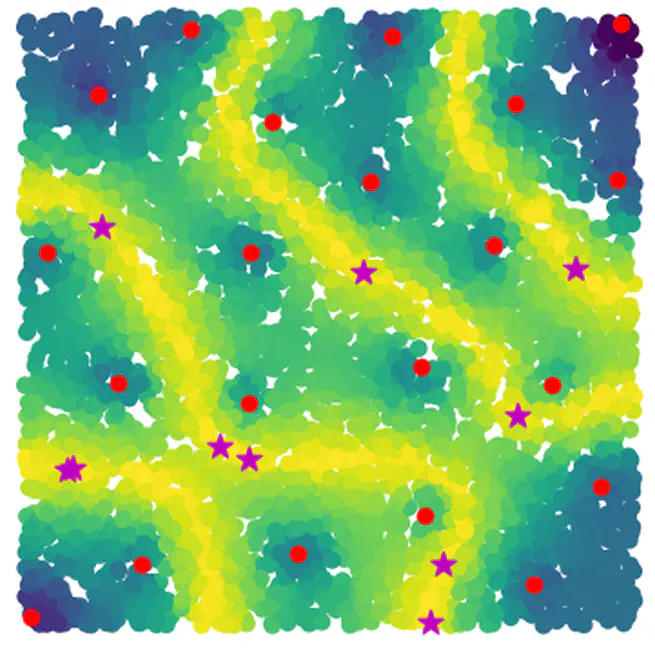
The paper introduces a two-stage strategy for making batch active learning nearly as accurate as sequential querying while substantially reducing the number of classifier updates. Dijkstra’s Annulus Core-Set (DAC) first constructs a representative candidate set; LocalMax then selects a diverse batch by enforcing local maxima of the acquisition function on the data graph.
Jun 13, 2023