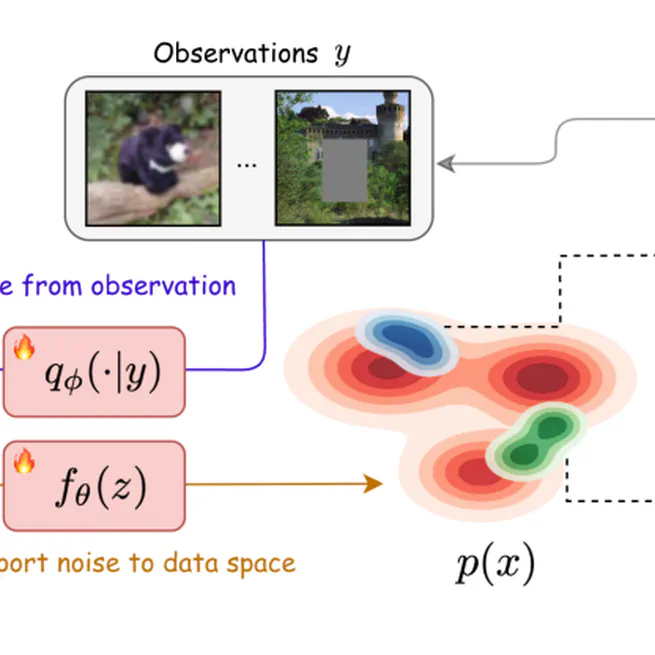
Variational Flow Maps: Make Some Noise for One-Step Conditional Generation
Variational Flow Maps (VFM) recasts conditional generation as a problem of learning the right initial noise distribution for a pretrained or jointly trained one-step flow map. An observation-dependent adapter transforms simple noise before the flow map sends it to data space, enforcing the measurement while retaining the learned data prior.
Jul 7, 2026
The CommUnity near-Surface Permafrost (CUSP) dataset a global compilation of permafrost observations and related properties to support AI/ML model development
The CommUnity near-Surface Permafrost (CUSP) dataset brings together geographically distributed observations of near-surface permafrost and related environmental attributes in a common resource. The compilation is designed to reduce the data-discovery and harmonization burden that often limits large-scale permafrost analysis.
Dec 1, 2024
Narrative Analysis of True Crime Podcasts With Knowledge Graph-Augmented Large Language Models
This work develops a knowledge-graph-augmented language-model pipeline for analyzing long, contested narratives. Using the first season of the Serial true-crime podcast as a case study, the system organizes people, claims, events, and relationships into a structure that can be queried while preserving connections across episodes and competing accounts.
Oct 1, 2024
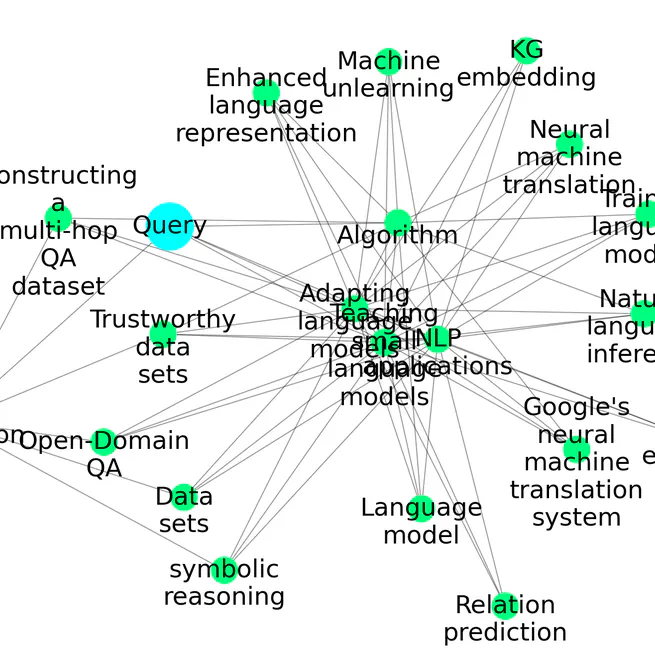
AutoKG: Efficient Automated Knowledge Graph Generation for Language Models
AutoKG is a lightweight pipeline for turning an unstructured text collection into a knowledge graph that can augment a large language model. An LLM extracts keywords from text blocks, and graph Laplace learning estimates relationships between keyword pairs without requiring a hand-designed ontology or end-to-end model fine-tuning.
Dec 18, 2023
Material Identification in Complex Environments: Neural Network Approaches to Hyperspectral Image Analysis
This study examines plastic identification in complex hyperspectral scenes, where illumination, background materials, spectral mixing, and within-class variation make pixel-level classification substantially harder than controlled laboratory sorting. The data include both visible and near-infrared measurements, making it possible to compare the practical value of different wavelength ranges.
Oct 1, 2023
Graph-Based Active Learning for Surface Water and Sediment Detection in Multispectral Images
The graph active learning pipeline (GAP) treats multispectral pixels as nodes in a similarity graph and uses graph Laplace learning to distinguish land, surface water, and in-river sediment. An acquisition function identifies the pixels whose expert labels are expected to improve the classifier most, directly targeting the expensive step of building a hand-labeled remote-sensing dataset.
Jul 1, 2023
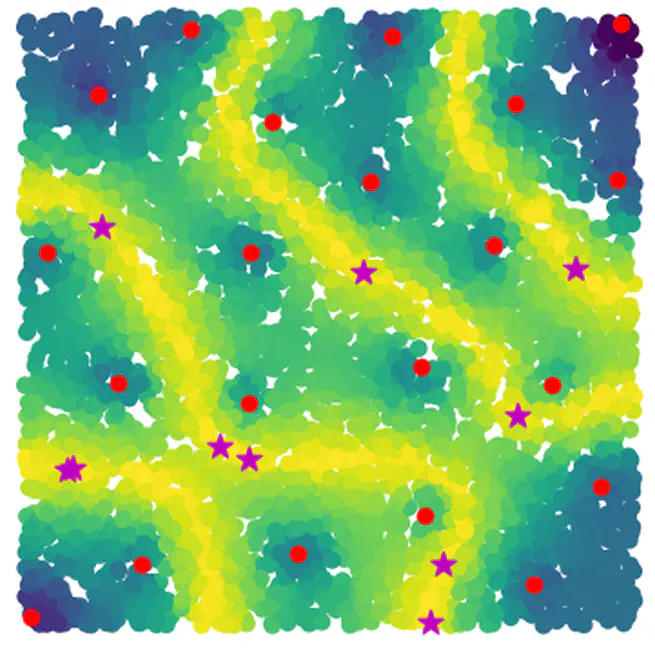
Novel batch active learning approach and its application to synthetic aperture radar datasets
The paper introduces a two-stage strategy for making batch active learning nearly as accurate as sequential querying while substantially reducing the number of classifier updates. Dijkstra’s Annulus Core-Set (DAC) first constructs a representative candidate set; LocalMax then selects a diverse batch by enforcing local maxima of the acquisition function on the data graph.
Jun 13, 2023