Flow Matching for Efficient and Scalable Data Assimilation
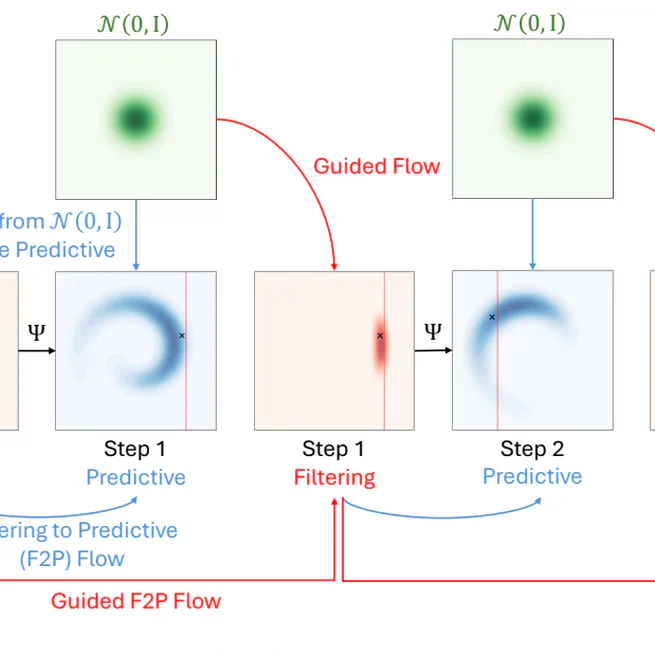
The ensemble flow filter (EnFF) is a training-free data-assimilation framework that uses flow matching to transform a forecast ensemble into samples from the filtering distribution. Its Monte Carlo flow-field estimator and localized observation guidance avoid model training while retaining the flexibility of generative flow design.
Jun 15, 2026
Learning Enhanced Ensemble Filters
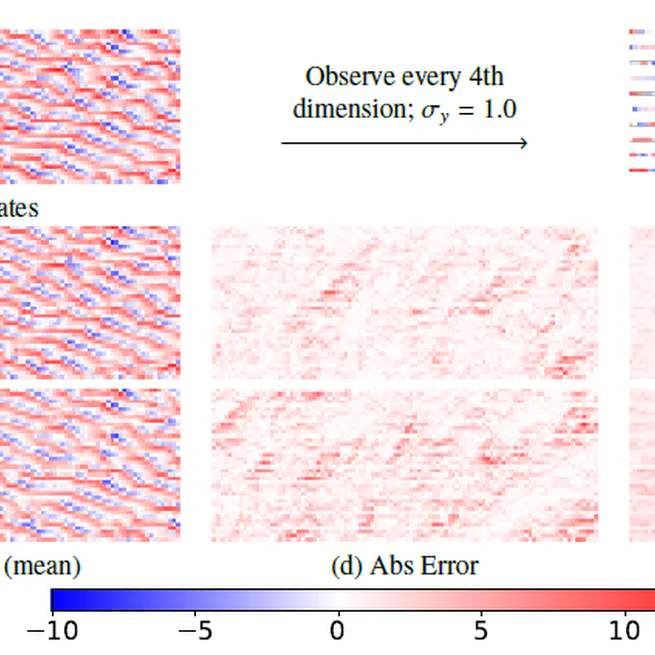
This work introduces the measure neural mapping enhanced ensemble filter (MNMEF), a learning-based data-assimilation method derived from a mean-field formulation of the filtering problem. Measure neural mappings extend neural operators to maps acting on probability measures; their finite-ensemble implementation uses a permutation-invariant set transformer.
Feb 15, 2026
CGAP: A Hybrid Contrastive and Graph-based Active Learning Pipeline to Detect Water and Sediment in Multispectral Images
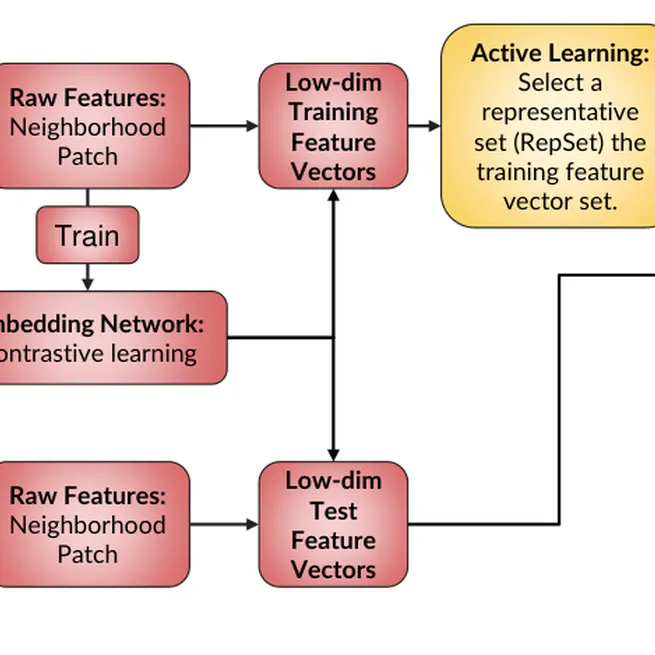
The contrastive graph-based active learning pipeline (CGAP) combines a learned feature embedding with graph Laplace learning to classify land, surface water, and near-water sediment in Landsat imagery. Custom contrastive augmentations make the features robust to geometric transformations, changes in spatial resolution, and light cloud cover while reducing the dimension used for graph construction.
Jun 7, 2024
Batch Active Learning for Multispectral and Hyperspectral Image Segmentation Using Similarity Graphs
This paper develops a graph-based pipeline for label-efficient multispectral and hyperspectral image segmentation. Pixels or local image patches are embedded as nodes of a similarity graph, and graph Laplace learning propagates the small number of queried labels across the image.
Jun 1, 2024
Graph-Based Active Learning for Nearly Blind Hyperspectral Unmixing
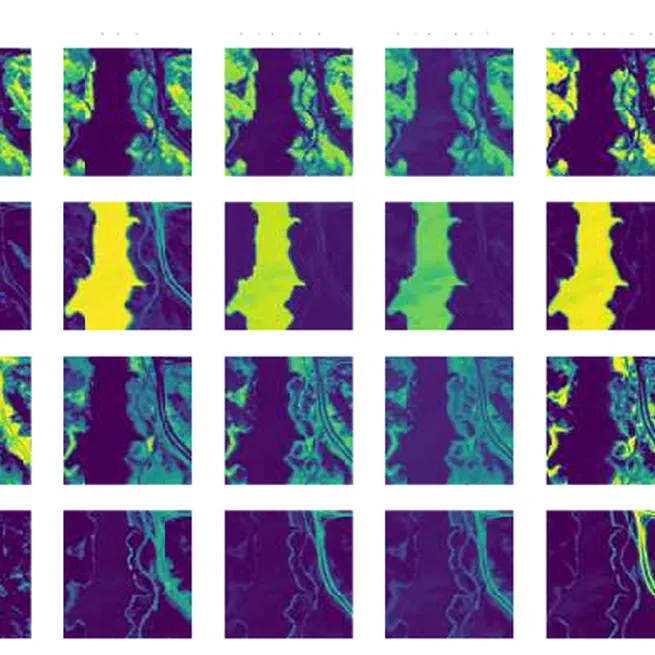
This work formulates nearly blind hyperspectral unmixing as a semi-supervised problem: instead of assuming all endmember spectra are known, it requests abundance information or simple one-hot pseudo-labels for only a very small set of pixels selected by graph-based active learning.
Sep 11, 2023
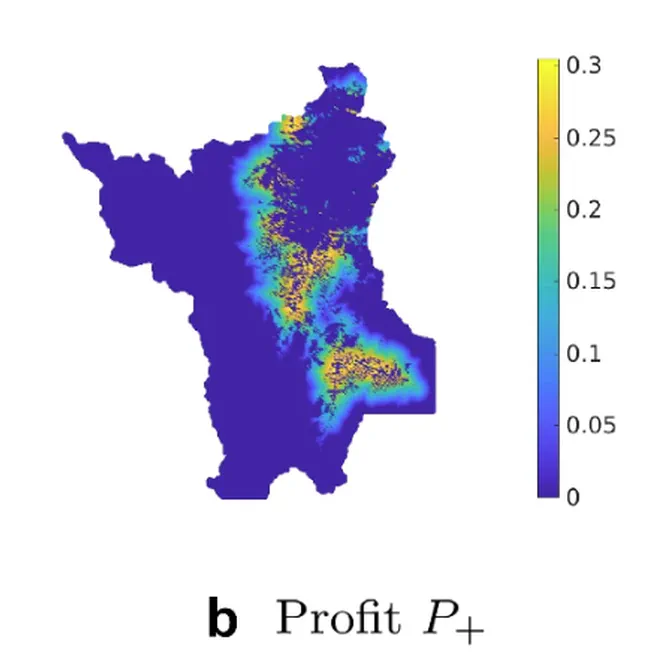
Modeling illegal logging in Brazil
This paper builds a continuous optimal-control model of illegal logging on general geographic domains. Loggers choose routes and harvesting behavior in response to resource value, travel cost, and law-enforcement pressure, while the model accounts for finite-time logging events and slower travel under heavier loads.
May 1, 2021