Flow Matching for Efficient and Scalable Data Assimilation
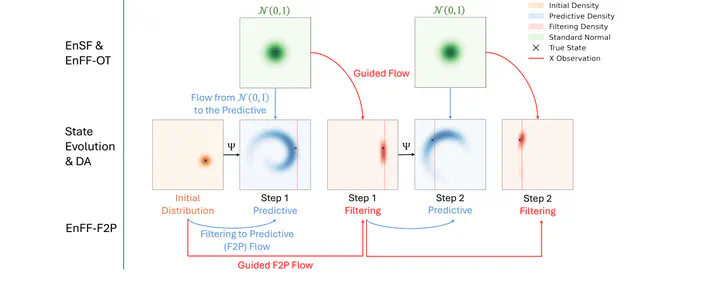
The ensemble flow filter (EnFF) is a training-free data-assimilation framework that uses flow matching to transform a forecast ensemble into samples from the filtering distribution. Its Monte Carlo flow-field estimator and localized observation guidance avoid model training while retaining the flexibility of generative flow design.
The paper introduces a filtering-to-predictive (F2P) flow that uses the previous filtering distribution, rather than a standard Gaussian, as its reference. This path is better aligned with sequential Bayesian filtering and improves efficiency and robustness when only a small number of sampling steps is available. The analysis also shows how EnFF recovers the bootstrap particle filter and ensemble Kalman filter under appropriate choices and assumptions.
Experiments span Lorenz-63, Lorenz-96, the one-dimensional Kuramoto–Sivashinsky system, and two-dimensional Navier–Stokes equations, including state dimensions up to a 256×256 grid. Across these benchmarks, EnFF provides a strong accuracy–cost trade-off and scales to nonlinear, high-dimensional data-assimilation problems.