Variational Flow Maps: Make Some Noise for One-Step Conditional Generation
Jul 7, 2026·
Abbas Mammadov
,
So Takao
,
Bohan Chen
,
Ricardo Baptista
,
Morteza Mardani
,
Yee Whye Teh
,
Julius Berner
· 1 min read
Abstract
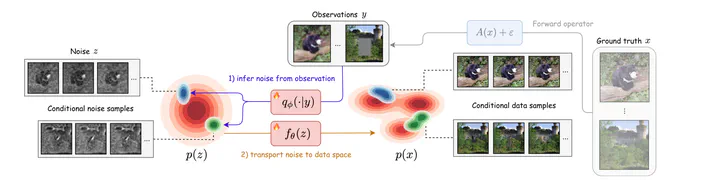
Flow maps enable high-quality image generation in a single forward pass. However, unlike iterative diffusion models, their lack of an explicit sampling trajectory impedes incorporating external constraints for conditional generation and solving inverse problems. We put forth Variational Flow Maps, a framework for conditional sampling that shifts the perspective of conditioning from “guiding a sampling path” to “learning the proper initial noise.” Given an observation, VFM learns a noise adapter that outputs a noise distribution whose samples are mapped to data space by a flow map, respecting both the observation and the data prior. A principled variational objective jointly trains the adapter and flow map to improve noise-data alignment. Across image inverse problems, VFM produces well-calibrated conditional samples in one or a few steps; on ImageNet, it achieves competitive fidelity while sampling orders of magnitude faster than iterative diffusion and flow baselines.
Type
Publication
Proceedings of the 43rd International Conference on Machine Learning (ICML 2026), PMLR 306

Variational Flow Maps (VFM) recasts conditional generation as a problem of learning the right initial noise distribution for a pretrained or jointly trained one-step flow map. An observation-dependent adapter transforms simple noise before the flow map sends it to data space, enforcing the measurement while retaining the learned data prior.

A variational training objective aligns the adapted noise with the conditional target and supports both amortized inverse-problem solving and reward-based alignment. Because the conditioning mechanism acts before generation, VFM avoids tracing and guiding the long sampling trajectories required by diffusion and iterative flow models.

Across image inverse problems and ImageNet conditional-generation tasks, VFM produces diverse, well-calibrated samples in one or a few network evaluations. The results combine competitive fidelity with orders-of-magnitude faster sampling than iterative diffusion and flow baselines.