Modeling illegal logging in Brazil
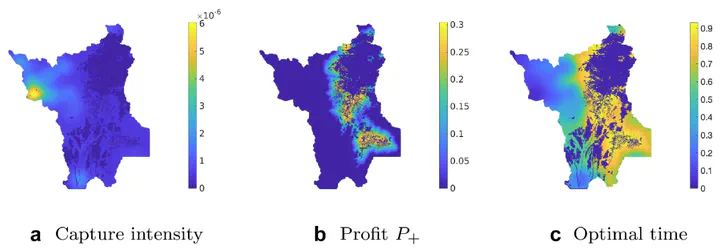
This paper builds a continuous optimal-control model of illegal logging on general geographic domains. Loggers choose routes and harvesting behavior in response to resource value, travel cost, and law-enforcement pressure, while the model accounts for finite-time logging events and slower travel under heavier loads.
The competing objectives are expressed through Hamilton–Jacobi–Bellman and level-set methods, producing spatial predictions of attractive logging locations and transport paths. Calibrating the model with observed deforestation in the Brazilian rainforest makes it possible to compare patrol strategies under realistic terrain and economic conditions.
The numerical results show that enforcement is most effective when it is geographically targeted rather than distributed uniformly. The framework provides a quantitative way to study how patrol placement changes the incentives and routes of environmental offenders.