Abstract
Hyperspectral unmixing (HSU) is an effective tool to ascertain the material composition of each pixel in a hyperspectral image with typically hundreds of spectral channels. In this article, we propose two graph-based semisupervised unmixing methods. The first one directly applies graph learning to the unmixing problem, while the second one solves an optimization problem that combines the linear unmixing model and a graph-based regularization term. Following a semisupervised framework, our methods require a very small number of training pixels that can be selected by a graph-based active learning method. We assume to obtain the ground-truth information at these selected pixels, which can be either the exact (EXT) abundance value or the one-hot (OH) pseudo-label. In practice, the latter is much easier to obtain, which can be achieved by minimally involving a human in the loop. Compared with other popular blind unmixing methods, our methods significantly improve performance with minimal supervision. Specifically, the experiments demonstrate that the proposed methods improve the state-of-the-art blind unmixing approaches by 50% or more using only 0.4% of training pixels.
Type
Publication
IEEE Transactions on Geoscience and Remote Sensing
This work formulates nearly blind hyperspectral unmixing as a semi-supervised problem:
instead of assuming all endmember spectra are known, it requests abundance information or
simple one-hot pseudo-labels for only a very small set of pixels selected by graph-based
active learning.
Two complementary models are introduced. Graph Learning Unmixing (GLU) interprets graph
Laplace class probabilities directly as abundance maps and then estimates the endmembers.
Graph-Regularized Semi-supervised Unmixing (GRSU) combines the linear mixing model,
nonnegativity and sum-to-one constraints, graph regularization, and supervision on the
queried pixels in a joint optimization problem initialized by GLU.
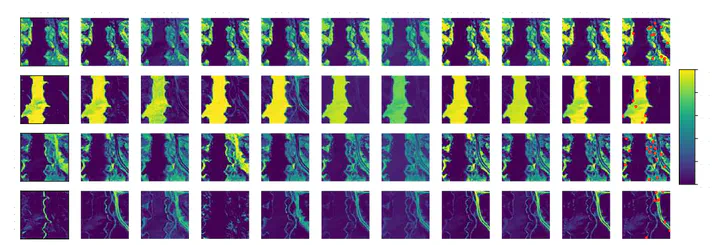
Experiments on Urban, Samson, and Jasper Ridge imagery show that both exact abundances and
easy-to-obtain one-hot labels substantially improve blind-unmixing baselines. With only
0.4% of pixels labeled, the proposed methods improve state-of-the-art blind approaches by
50% or more on the reported reconstruction and abundance-estimation metrics.