Novel batch active learning approach and its application to synthetic aperture radar datasets
Jun 13, 2023·,,,,,·
1 min read
James Chapman
Bohan Chen
Zheng Tan
Jeff Calder
Kevin Miller
Andrea L. Bertozzi
Abstract
Active learning improves the performance of machine learning methods by judiciously selecting a limited number of unlabeled data points to query for labels, with the aim of maximally improving the underlying classifiers performance. Recent gains have been made using sequential active learning for synthetic aperture radar (SAR) data.1 In each iteration, sequential active learning selects a query set of size one while batch active learning selects a query set of multiple datapoints. While batch active learning methods exhibit greater efficiency, the challenge lies in maintaining model accuracy relative to sequential active learning methods. We developed a novel, two-part approach for batch active learning: Dijkstra’s Annulus Core-Set (DAC) for core-set generation and LocalMax for batch sampling. The batch active learning process that combines DAC and LocalMax achieves nearly identical accuracy as sequential active learning but is more efficient, proportional to the batch size. As an application, a pipeline is built based on transfer learning feature embedding, graph learning, DAC, and LocalMax to classify the FUSAR-Ship and OpenSARShip datasets. Our pipeline outperforms the state-of-the-art CNN-based methods.
Type
Publication
Algorithms for Synthetic Aperture Radar Imagery XXX
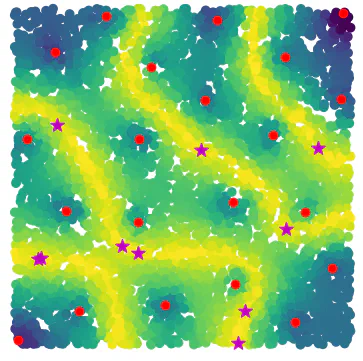
The paper introduces a two-stage strategy for making batch active learning nearly as accurate as sequential querying while substantially reducing the number of classifier updates. Dijkstra’s Annulus Core-Set (DAC) first constructs a representative candidate set; LocalMax then selects a diverse batch by enforcing local maxima of the acquisition function on the data graph.
The resulting pipeline combines transfer-learned image features, graph-based semi-supervised learning, DAC, and LocalMax for synthetic-aperture-radar target classification. On FUSAR-Ship and OpenSARShip, it retains the accuracy of sequential active learning with speedups that scale with batch size and outperforms the evaluated CNN-based baselines.