Abstract
Standard deep learning architectures used for classification generate label predictions with a projection head and softmax activation function. Although successful, these methods fail to leverage the relational information between samples in the batch for generating label predictions. In recent works, graph-based learning techniques, namely Laplace learning, have been heuristically combined with neural networks for both supervised and semi-supervised learning (SSL) tasks. However, prior works approximate the gradient of the loss function with respect to the graph learning algorithm or decouple the processes; end-to-end integration with neural networks is not achieved. In this work, we derive backpropagation equations, via the adjoint method, for inclusion of a general family of graph learning layers into a neural network. This allows us to precisely integrate graph Laplacian-based label propagation into a neural network layer, replacing a projection head and softmax activation function for classification tasks. Using this new framework, our experimental results demonstrate smooth label transitions across data, improved robustness to adversarial attacks, improved generalization, and improved training dynamics compared to the standard softmax-based approach. Our code is available at
Type
Publication
arXiv
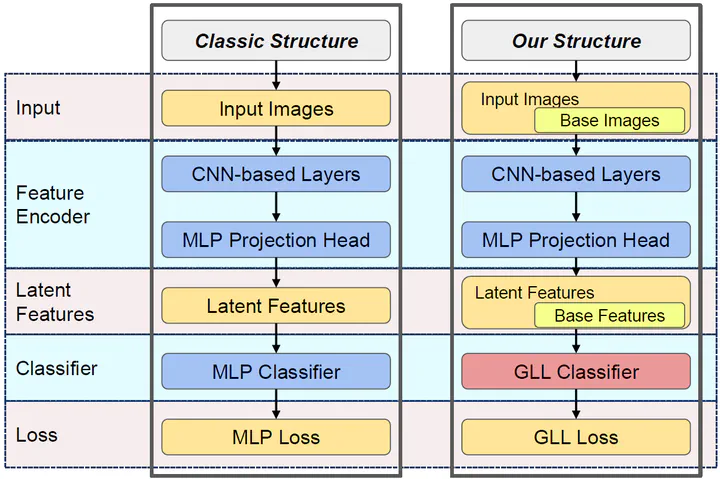
The graph learning layer (GLL) replaces the usual projection head and softmax
classifier with graph-Laplacian label propagation. Samples in a minibatch become nodes of
a similarity graph, allowing predictions to use relationships among examples instead of
classifying each representation independently.
The main technical contribution is an exact end-to-end differentiation rule for a broad
family of graph learning methods. By deriving the backward pass with the adjoint method,
the graph solver can participate directly in neural-network training rather than being
detached from the feature extractor or differentiated through a heuristic approximation.
Experiments show smoother transitions between classes, improved optimization and
generalization, and stronger resistance to adversarial perturbations than a conventional
softmax head. The framework supports both supervised and semi-supervised learning and is
released with an open-source implementation.