Abstract
Bayesian filtering of partially and noisily observed dynamical systems seeks to infer the evolving conditional distribution of the state of a dynamical system, given observations, in an online fashion. This Bayesian filtering distribution is the natural object for uncertainty quantification, but it is rarely available as a supervised learning target. However, one can often use the forecast model to generate synthetic system trajectories, along with synthetic observations. We introduce the proper scoring ensemble filter (PSEF), an ensemble data assimilation method based on training an analysis map to approximate the filtering distribution using only synthetic state–observation trajectories. The analysis step is represented as a permutation-invariant, transformer-based map that takes as input a forecast ensemble and observations, producing an analysis ensemble. Training is based on strictly proper scoring rules—with the energy score used in our implementation—so that probabilistic accuracy is rewarded over the whole probability distribution. We prove that, under a realizability assumption, the population objective is minimized by the true Bayesian filtering distribution. We also derive the finite-ensemble empirical objective used in training and relate its single state–observation trajectory form to the population objective, using a mean-field consistency argument. Numerical experiments show that the learned filter accurately approximates challenging filtering distributions, including nonlinear, non-Gaussian, and multi-modal posteriors, and achieves stronger performance in data assimilation tasks than classical methods or learning-based methods with mean-squared-error objectives. For close-to-Gaussian problems, learning a correction to the EnKF is the best approach, while for highly non-Gaussian problems an end-to-end approach that discards this inductive bias is superior.
Type
Publication
Submitted to the Journal of Machine Learning Research
The proper scoring ensemble filter (PSEF) learns an ensemble analysis operator that
targets the complete Bayesian filtering distribution rather than only its conditional mean.
The operator takes a forecast ensemble and a new observation as input and returns an
analysis ensemble. A permutation-invariant transformer ensures that the result respects the
exchangeability of ensemble members and can be evaluated at different ensemble sizes.
The key training device is a strictly proper scoring rule, implemented with the energy
score. Its expected value is uniquely minimized by the true filtering distribution, yet its
empirical form requires only simulated state–observation trajectories—not direct access to
the generally intractable filtering distribution. Under a realizability assumption, the
population objective recovers the Bayesian filter, and a mean-field time-averaging argument
connects the practical single-trajectory objective to this population target.
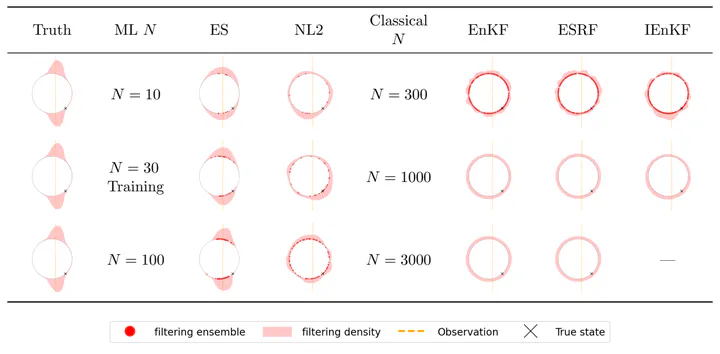
Experiments cover a linear–Gaussian diagnostic, the strongly non-Gaussian doubling-angle
model, Lorenz-63, and Lorenz-96. Energy-score training captures multimodal distributions
missed by Gaussian filters and mean-based learning objectives. The results also reveal a
useful architectural distinction: an EnKF correction provides an effective inductive bias in
close-to-Gaussian problems, while a flexible end-to-end update is better suited to strongly
non-Gaussian posterior geometry.
The manuscript has been submitted to the Journal of Machine Learning Research.