Learning the Whole Filtering Distribution with Proper Scoring Rules

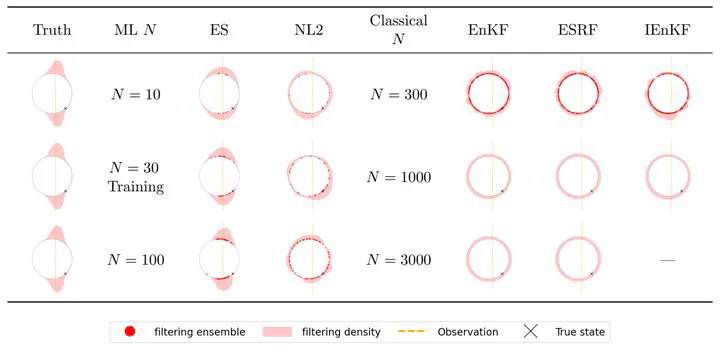
Table of Contents
Our new paper, “Learning Probabilistic Filters with Strictly Proper Scoring Rules,” is now available on arXiv and has been submitted to the Journal of Machine Learning Research (JMLR).
- Paper: arXiv · local PDF
- Code: wispcarey/Proper-Scoring-Ensemble-Filter
- Publication page and BibTeX: Learning Probabilistic Filters with Strictly Proper Scoring Rules
- Original announcement: Eviatar Bach’s LinkedIn post
Learning a Distribution Without Seeing It
Bayesian filtering aims to infer the evolving distribution of a hidden state from partial and noisy observations. That full distribution—not only its mean—is what represents uncertainty, multimodality, and the range of plausible system states.
This creates a basic learning problem: the true filtering distribution is generally intractable, so it is not available as a supervised target. A simulator can readily produce state trajectories and their corresponding noisy observations, but it does not hand us the conditional distribution we would like a filter to learn.
Our solution is to change the training objective. A strictly proper scoring rule evaluates a predictive distribution against a realized state, and its expected score is uniquely optimized by the true data-generating distribution. We use the energy score, which lets us train from simulated state–observation trajectories while still targeting the entire Bayesian filtering distribution.
The Proper Scoring Ensemble Filter
We introduce the proper scoring ensemble filter (PSEF). Its learned analysis map takes a forecast ensemble and the latest observation, then outputs an updated analysis ensemble. The map is implemented with a permutation-invariant transformer, respecting the fact that an ensemble represents an unordered empirical distribution. The same parameterization can also operate across different ensemble sizes, with lightweight fine-tuning where needed.
The paper studies two ways to parameterize the update:
- Correction terms: retain the EnKF update as an inductive bias and learn how to correct it.
- End to end: learn a more flexible analysis map without constraining it to an EnKF-style correction.
The distinction matters. In close-to-Gaussian settings, the EnKF structure is useful and the correction-based approach performs best. When the observation creates a strongly non-Gaussian or multimodal posterior, the end-to-end map has the flexibility needed to represent its geometry.
Why the Loss Function Matters
The header figure gives a controlled example on the doubling-angle model. The true posterior is bimodal. Training the same learning architecture with the energy score captures both modes across ensemble sizes, including ensembles much smaller than those used by the classical baselines. A normalized mean-squared objective and Kalman-type filters instead miss the distributional structure, because matching a conditional mean is not enough to learn uncertainty.
The theory mirrors this empirical difference. Under a realizability assumption, the population proper-scoring objective is minimized by the true Bayesian filtering distribution. We also connect the finite-ensemble, single-trajectory loss used in training to the population objective through a mean-field consistency and time-averaging argument.
Non-Gaussian Filtering in Lorenz Systems
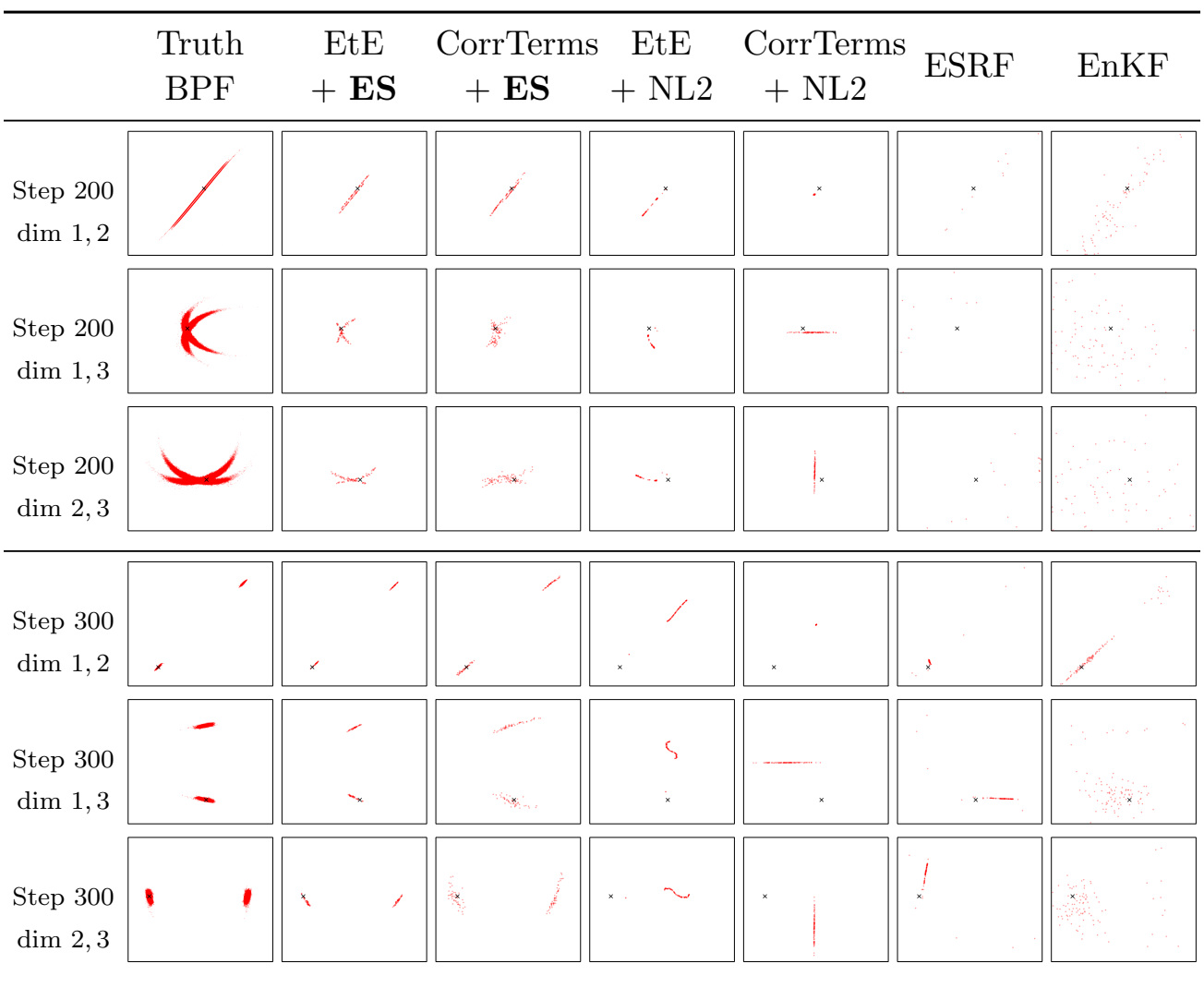
We evaluate PSEF on a linear–Gaussian diagnostic, the doubling-angle model, Lorenz-63, and Lorenz-96. In Lorenz-63, squaring the observed coordinate introduces sign ambiguity and produces complex non-Gaussian filtering distributions. The end-to-end PSEF trained with the energy score reproduces these structures more faithfully than mean-based learned filters and classical Gaussian ensemble filters.
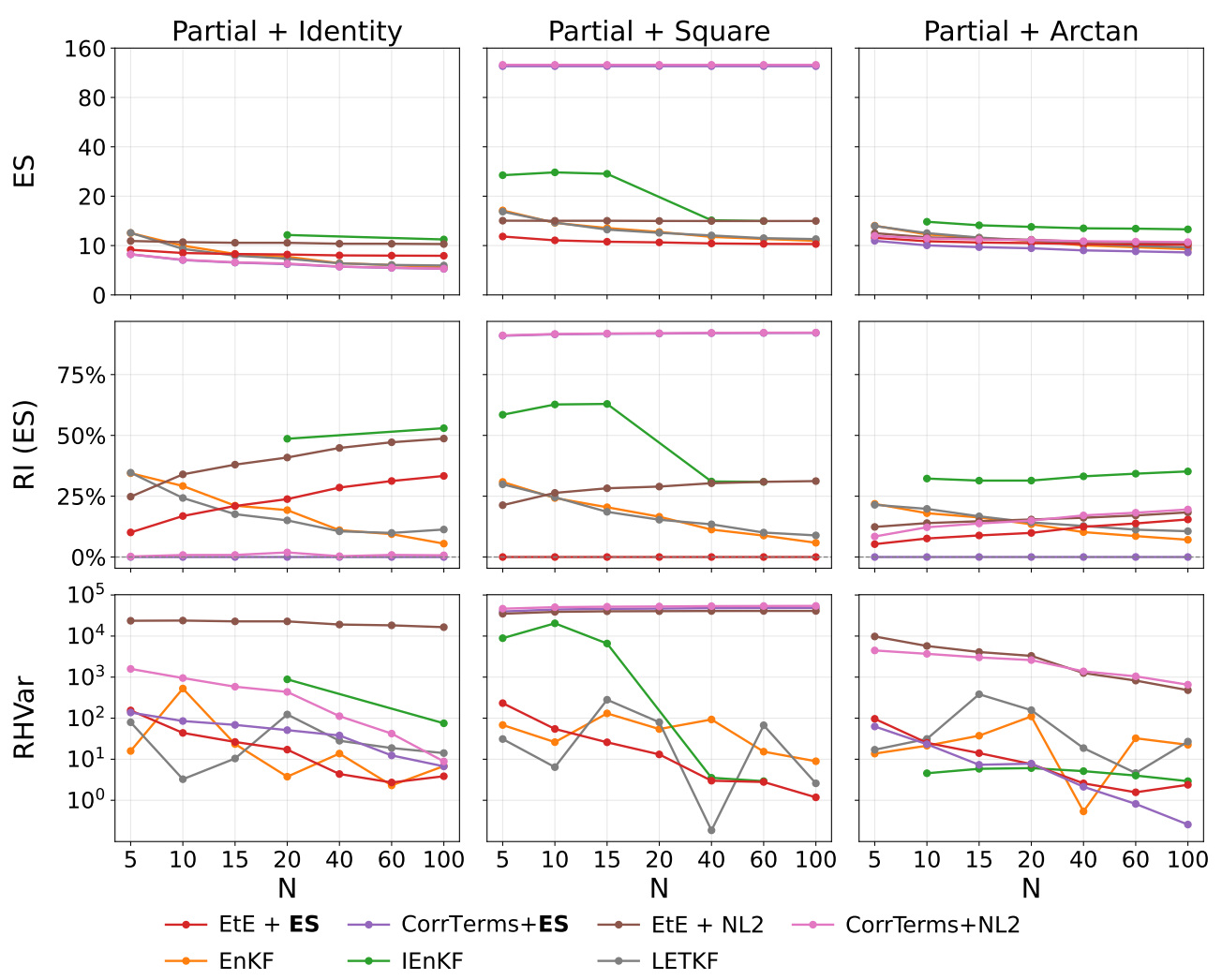
The Lorenz-96 results reinforce that there is no single architectural bias that is optimal for every problem. Correction terms are effective when the filtering distribution remains approximately unimodal, whereas the end-to-end energy-score model is strongest when the observation induces multimodality. Across both cases, probabilistic training is what allows the learned ensemble to target distributional accuracy rather than only state-estimation error.
Collaboration and Reproducibility
I led this project, including the implementation and numerical experiments, in collaboration with Eviatar Bach, Ricardo Baptista, Jochen Bröcker, and Andrew Stuart. The project repository contains the code and experiment scripts.
Figures on this page were extracted from the paper, which is available under a CC BY 4.0 license.