Flow Matching for Data Assimilation Accepted in SIAM/ASA JUQ

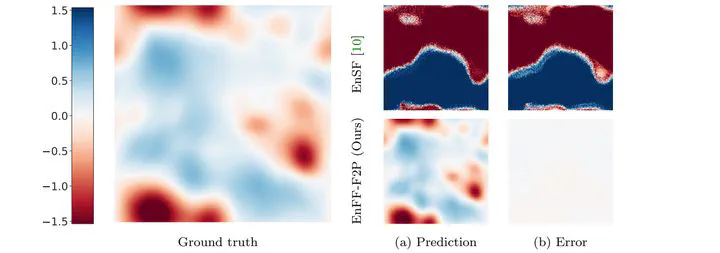
Table of Contents
I am happy to share that our paper, “Flow Matching for Efficient and Scalable Data Assimilation,” has been accepted for publication in the SIAM/ASA Journal on Uncertainty Quantification.
- Paper: arXiv · local PDF
- Code: Utah-Math-Data-Science/Data-Assimilation-Flow-Matching
- Publication page and BibTeX: Flow Matching for Efficient and Scalable Data Assimilation
- Journal: SIAM/ASA Journal on Uncertainty Quantification
Why Flow Matching for Data Assimilation?
Data assimilation combines a dynamical model with noisy observations to estimate a system’s evolving state. Classical ensemble filters are efficient but can struggle with nonlinear or non-Gaussian distributions. More expressive generative approaches can address those settings, but methods such as the ensemble score filter require many sampling steps and can become expensive in large systems.
Our goal was to retain the expressiveness of a generative method while making the sampling process faster, training-free, and easier to scale.
The Ensemble Flow Filter
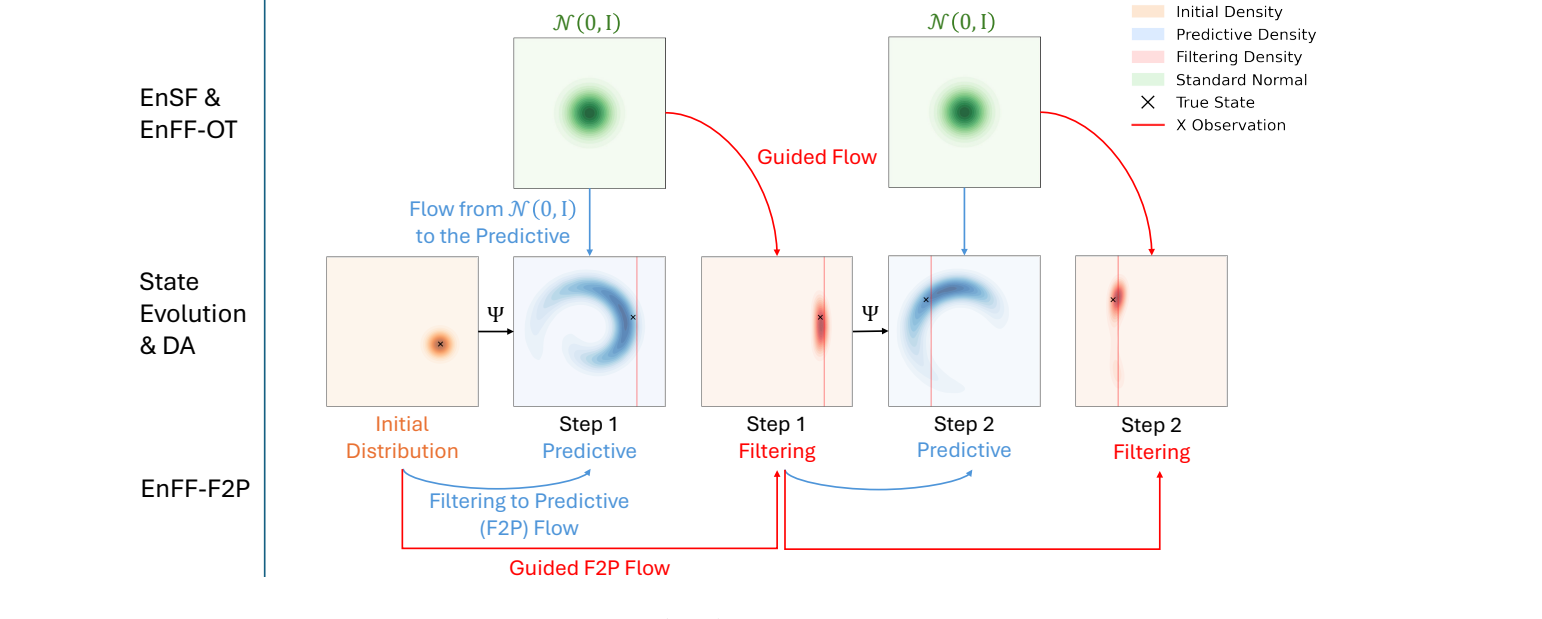
We introduce the ensemble flow filter (EnFF), a flow-matching framework for sequential Bayesian data assimilation. It does not require an offline training stage. Instead, it constructs a Monte Carlo estimate of the marginal flow field from the current ensemble and incorporates each observation through localized guidance.
A central ingredient is the filtering-to-predictive (F2P) flow. Standard generative filters repeatedly transport samples from a Gaussian reference distribution. F2P instead starts from the previous filtering ensemble and transports it toward the next predictive distribution. This uses the structure already present in Bayesian filtering, producing a more direct path and more stable behavior when the number of sampling steps is small.
The framework also connects new generative filters with classical methods. Under appropriate flow choices and assumptions, EnFF recovers the bootstrap particle filter and the ensemble Kalman filter.
Accuracy, Efficiency, and Scale
We evaluate EnFF on Lorenz-63, Lorenz-96, the one-dimensional Kuramoto–Sivashinsky equation, and the two-dimensional Navier–Stokes equations, using both identity and nonlinear observation operators. The experiments range from compact chaotic systems to a Navier–Stokes pressure field on a 256×256 grid.
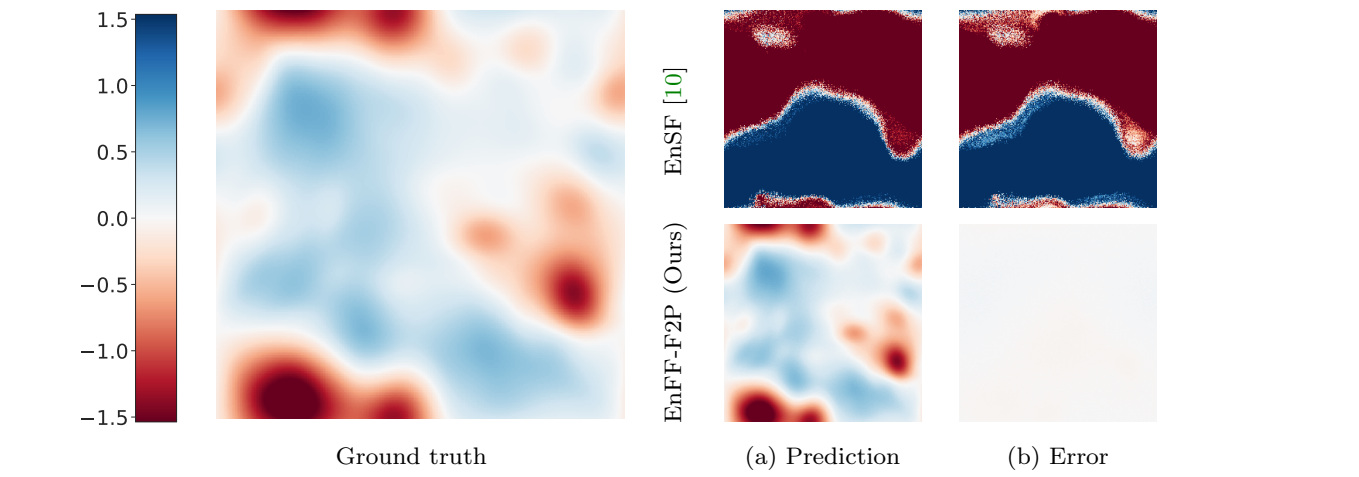
The results show that EnFF can match or improve the ensemble score filter while using far fewer sampling steps, with the advantage becoming more pronounced as the sampling budget decreases. EnFF-F2P is also less sensitive to its flow hyperparameters across different step counts.
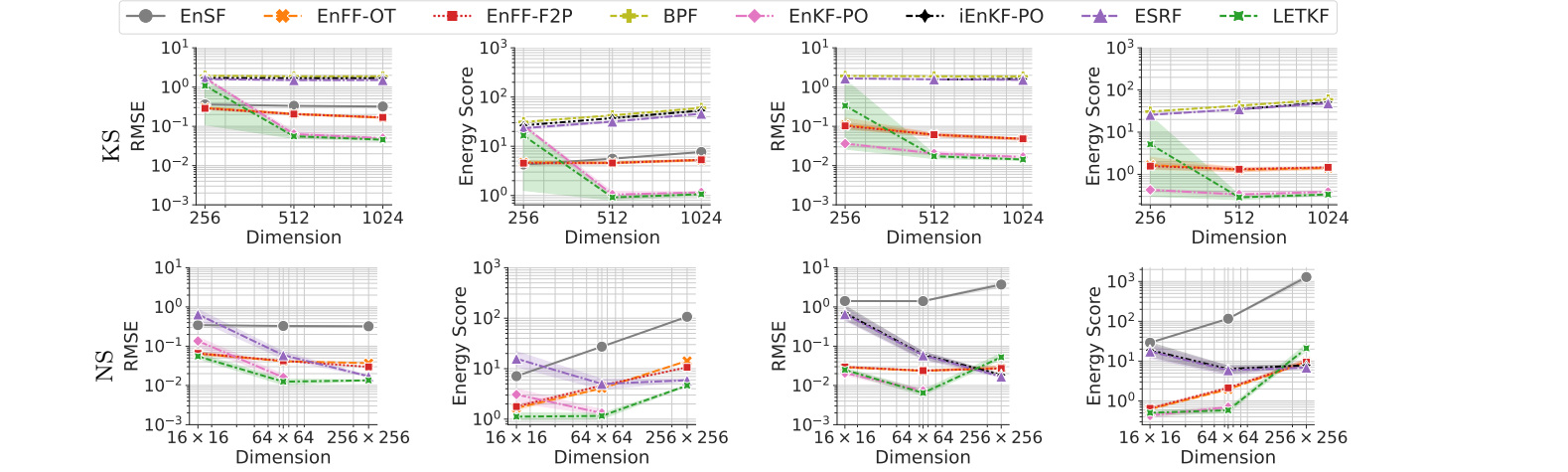
Across the high-dimensional benchmarks, EnFF offers a favorable balance of filtering accuracy, distributional quality, runtime, and stability. These results suggest that flow design—not only the choice of generative model—is a useful lever for building practical data-assimilation algorithms.
Collaboration and Reproducibility
This work was a rewarding collaboration with Taos Transue, So Takao, and Bao Wang. Taos Transue and I contributed equally. The accompanying repository contains the implementation and experiment code.
Figures on this page were extracted from the latest version of the paper.